Cutting KYB from 50 to 15 minutes at Qashio
Teams weren't stuck on the questions — they were stuck waiting on each other. I rebuilt onboarding around who does what, and when.
- Problem
- Finance teams abandoned KYB two-thirds of the way in and finished it over email with customer success. 70% never completed the form on their own.
- My call
- Rebuilt onboarding as a parallel team task instead of a single-player form — invite, delegate, and keep working while approvers sign in their own channel.
- Proof
- 50 → 15 minutes to complete, CS tickets down 38% in three weeks, activation up 22%.
- Client
- Qashio — Corporate spend & card platform
- Role
- Product Designer
- Year
- 2024 — 2026
- Tools
- Figma · PostHog · Cursor · Claude · JIRA
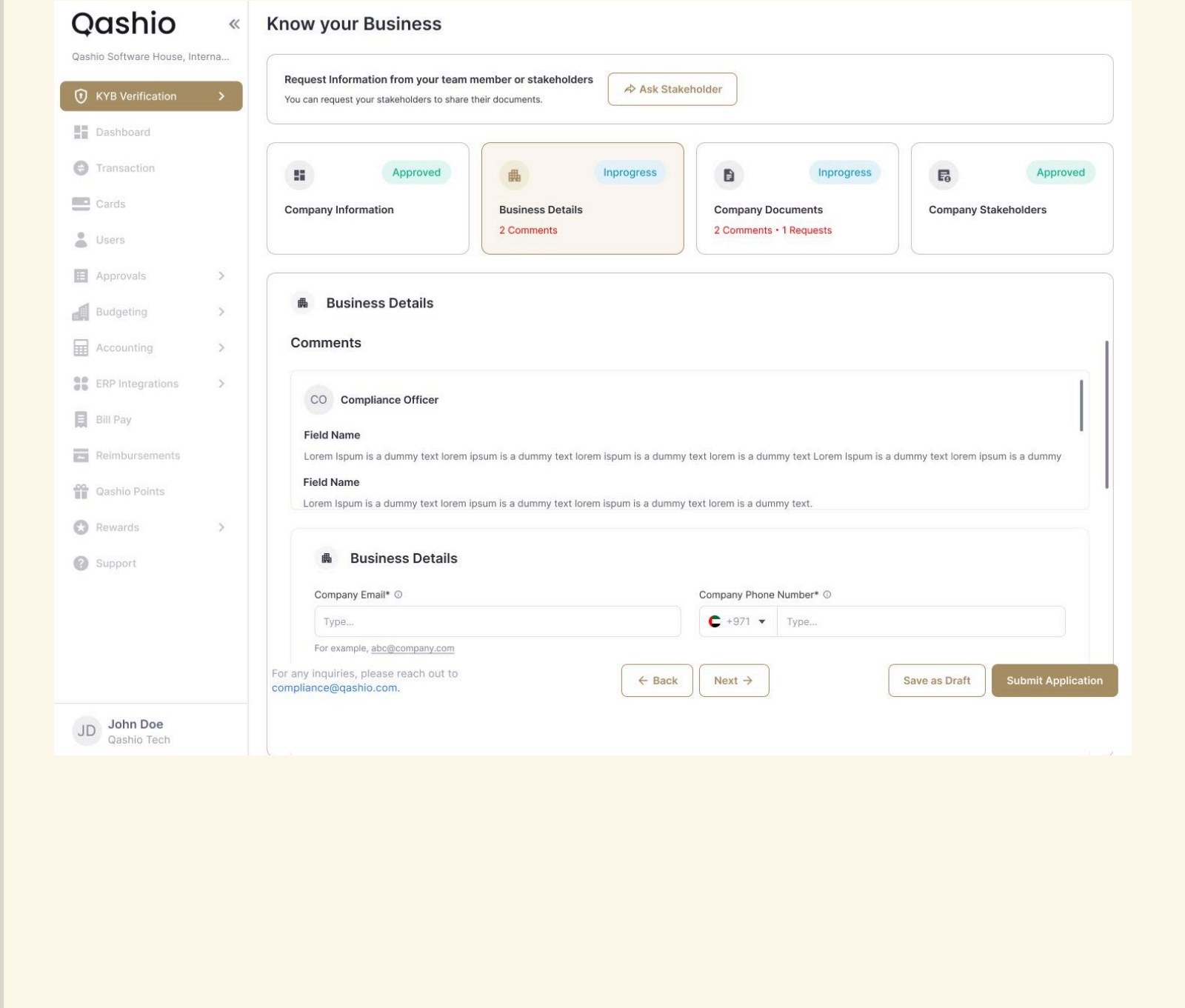
KYB — sectioned, live status 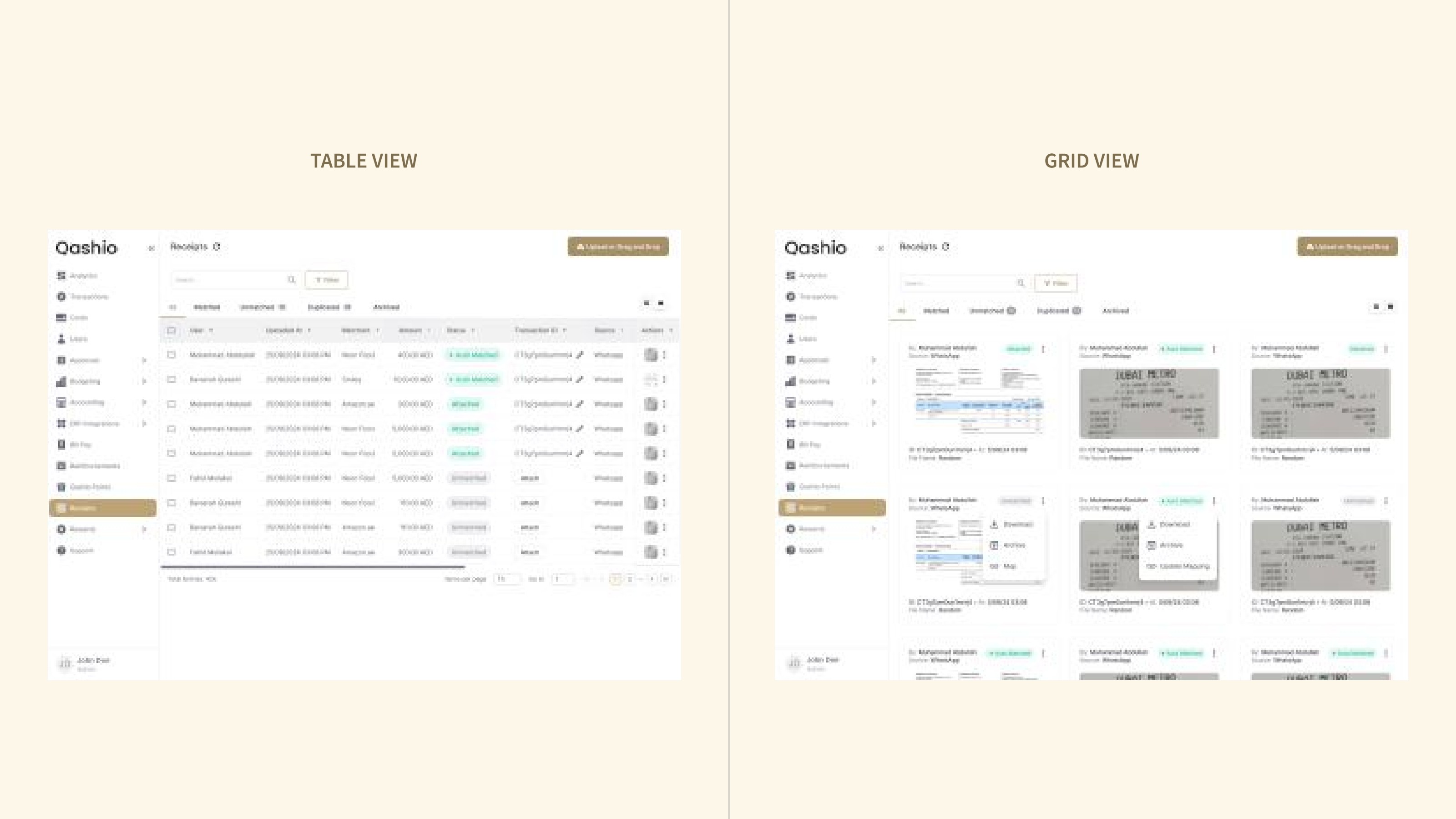
Receipt Inbox — table & grid 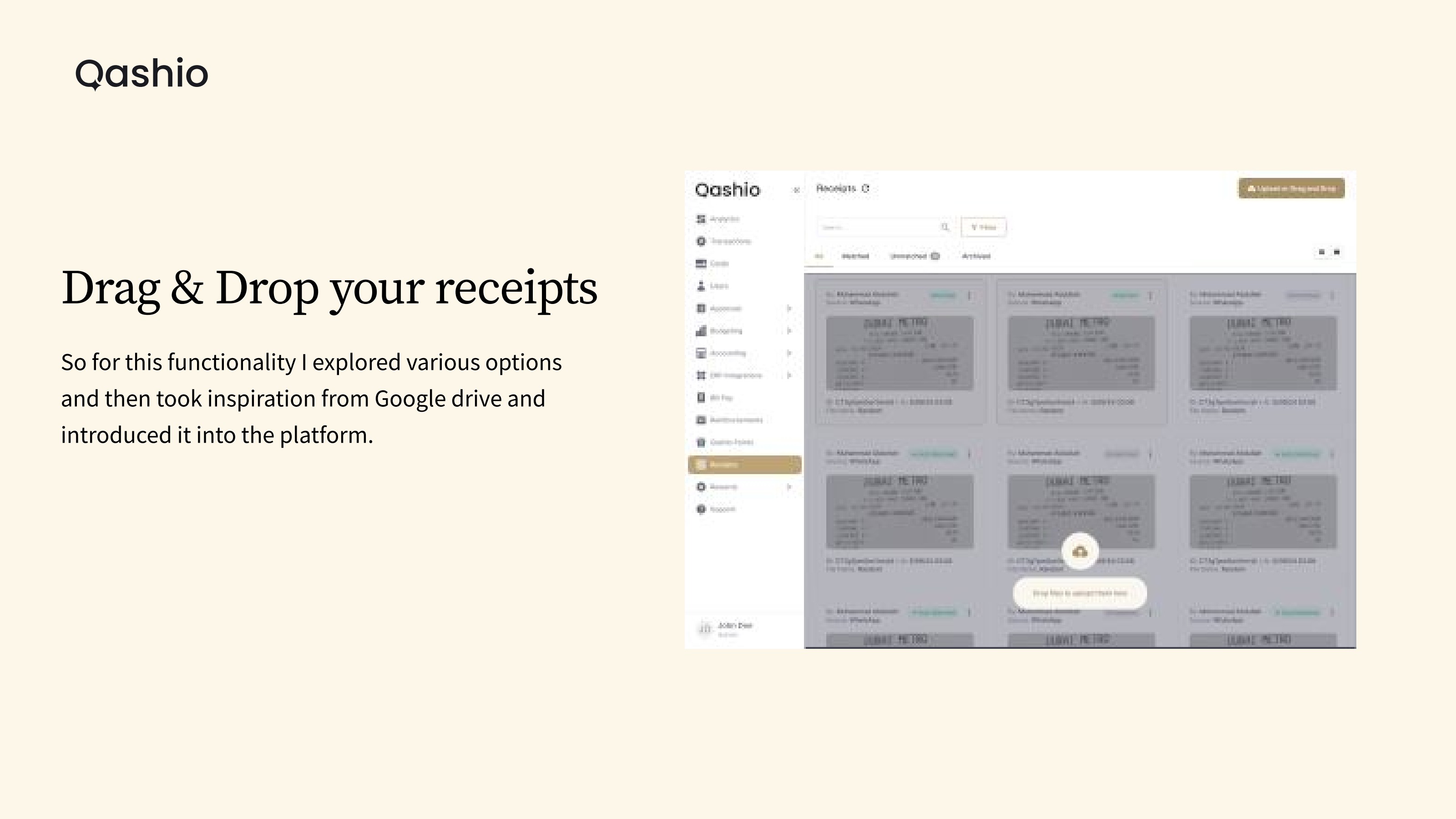
Bulk upload — drag & drop 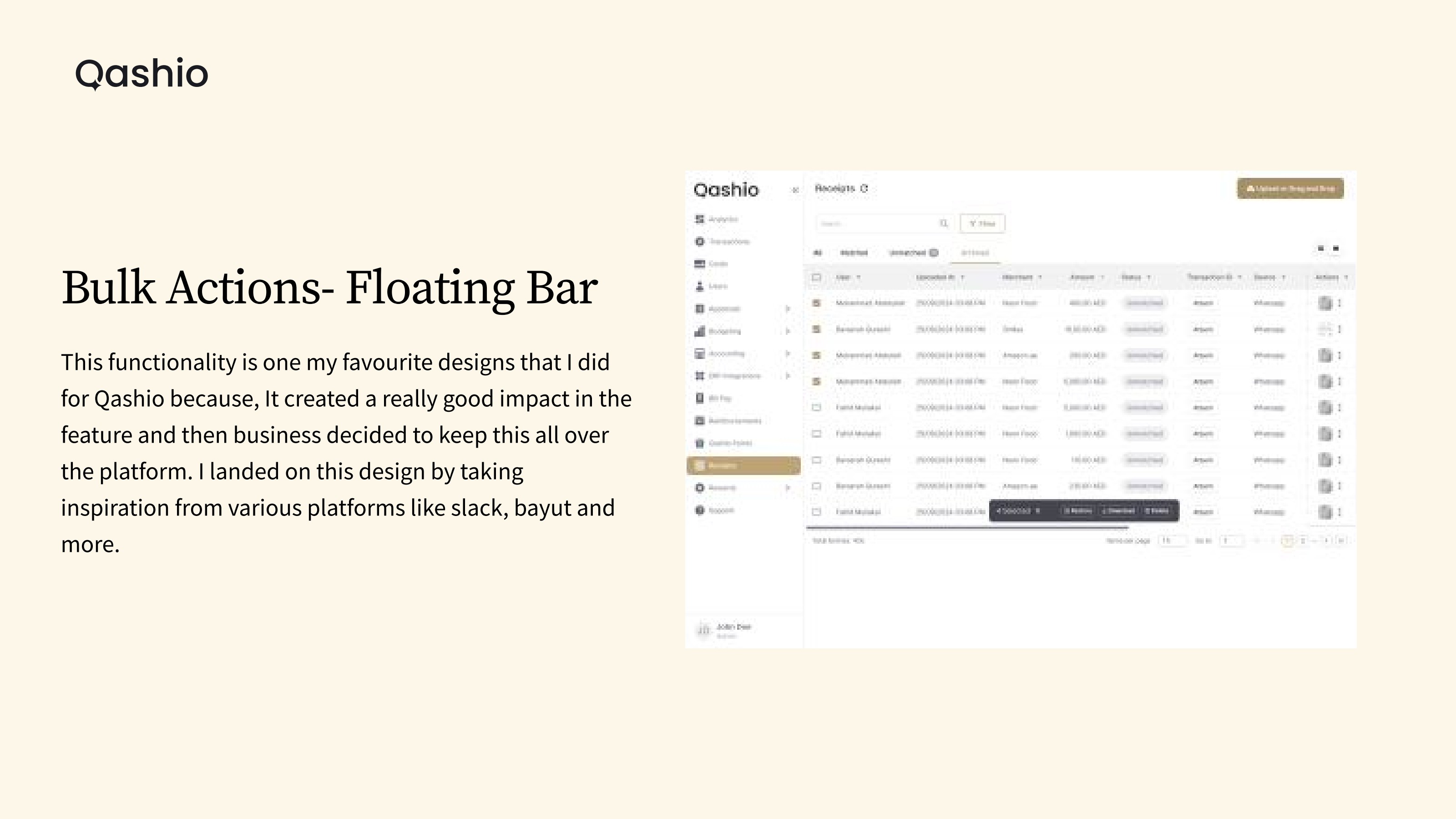
Floating bulk-action bar
Method, insight, decision, tradeoff.
The four beats that turn a project into evidence — how I researched it, what I learned, the call I made, and the compromise I accepted to make the call.
6 weeks of interviews with finance + compliance, five moderated onboarding sessions, plus a PostHog funnel audit of every step in production.
Teams weren't stuck on the questions — they were stuck waiting on each other. Every dropout mapped to a handoff the flow assumed one person owned.
Split KYB into a parallel path: admins invite documents, delegate role assignment, and continue in the app while approvers sign in a separate channel. Progress moved from a step counter to a live team board.
A more complex mental model on day one (roles, delegation, statuses) in exchange for a flow finance teams could actually finish without CS help.
Phases, decisions, artifacts, outcomes.
The actual shape of the work — not the marketing version. Each phase lists the calls I made, what shipped, and what moved.
Discover
- Interview compliance + finance, not just admins.
- PostHog funnel audit over a fresh survey — the data was already there.
- 12 interviews, 5 moderated onboarding sessions.
- End-to-end funnel with drop-off attribution.
Named the real failure mode: teams waiting on each other, not on the form.
Define
- Parallel-path KYB, not a shorter linear one.
- Progress moves from step counter to a live team board.
- Reference flow + role-permission matrix.
- Auto-onboarding data spec, co-authored with backend.
Committed the team to a delegation model, not a form redesign.
Design
- Consolidate ~30 components into tokens before touching flows.
- Ship mobile and web in parallel from one source of truth.
- Redesigned KYB, invoice engine, receipt matcher.
- Token-backed component library + handoff doc.
Design-to-dev handoff on common screens: days → hours.
Ship & Measure
- Staged rollout by cohort, not a big-bang release.
- PostHog events wired into the QA plan, not bolted on after.
- QA test plan, release notes, live funnel dashboard.
KYB 50 → 15 min · Activation +22% · Invoice tool at 80% adoption in month one.
Context
Qashio sells trust. Finance teams hand over their spend to a platform that promises control, and every minute of friction in onboarding erodes that promise before it can be tested.
The existing KYB flow took 50 minutes on average, ran across four disconnected surfaces, and quietly dropped 4 out of 10 businesses before their first card was ever issued. Fixing it meant designing the operational reality of a compliance team as much as designing an interface.
Constraints on the table
- Regulatory checks that could not be shortened, only re-sequenced.
- A live customer base already halfway through the old flow.
- Multi-role permissions — admins, approvers, cardholders — sharing the same screens.
- A mobile app and a web dashboard that had drifted apart over two years.
Research
Six weeks of interviews with finance leads and compliance officers, five moderated onboarding sessions with new customers, and a PostHog funnel audit of every step in production.
The findings converged on a single insight: teams weren't stuck on the questions, they were stuck waiting on each other. Every dropout mapped to a moment where the flow assumed one person was doing all the work.
Decisions
The redesign split KYB into a parallel path — admins could invite documents, delegate role assignment, and continue in the app while approvers signed in a separate channel. Progress state moved from a step counter to a live board that everyone on the team could see.
Auto-onboarding pulled trade licence data from government registries where possible. When it couldn't, the form gracefully surfaced only the fields that still needed a human answer.
Adjacent wins
The invoice and receipt system that shipped alongside the onboarding rework was adopted by 80% of active users in its first month. Smart matching cut duplicate submissions by 40% and let finance teams process five times as many receipts per session.
The design system consolidation that supported the work reduced component variants by roughly a third, and I built the handoff patterns that took the design-to-dev cycle from days to hours for the team's most common screens.
Deep dive · the KYB rebuild
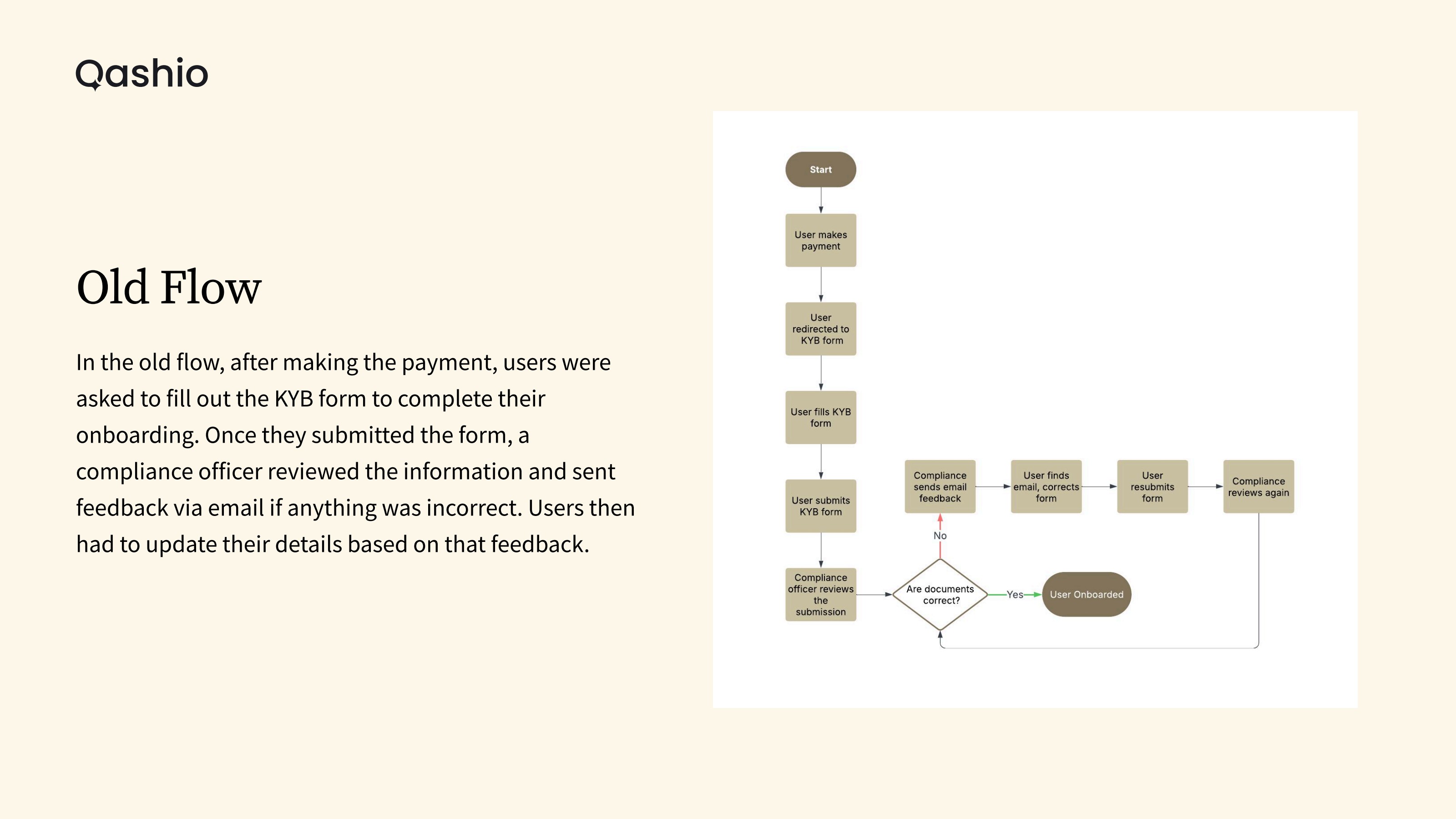
Seventy percent of new businesses were not finishing KYB on their own — after paying for the platform, they hit the form, stalled, and fell back on customer success to collect information over email. The old flow was a submit–wait–email round-trip that could span days.
The redesign split KYB into four independent sections — Company Info, Business Details, Company Documents, Stakeholders — each holding its own state (Not Started, Saved, In Review, Approved, Rejected). Compliance officers now comment on specific fields inside the form, and an applicant can invite a co-founder or accountant to fill just their section without handing over the account.
Two iterations were documented and killed before sign-off: an accordion that collapsed under real content, and a linear stepper that reintroduced exactly the constraint that had killed the old flow. Internal usability caught the last real issue — tiles that didn't read as interactive — fixed with explicit back and next affordances before the limited external rollout.
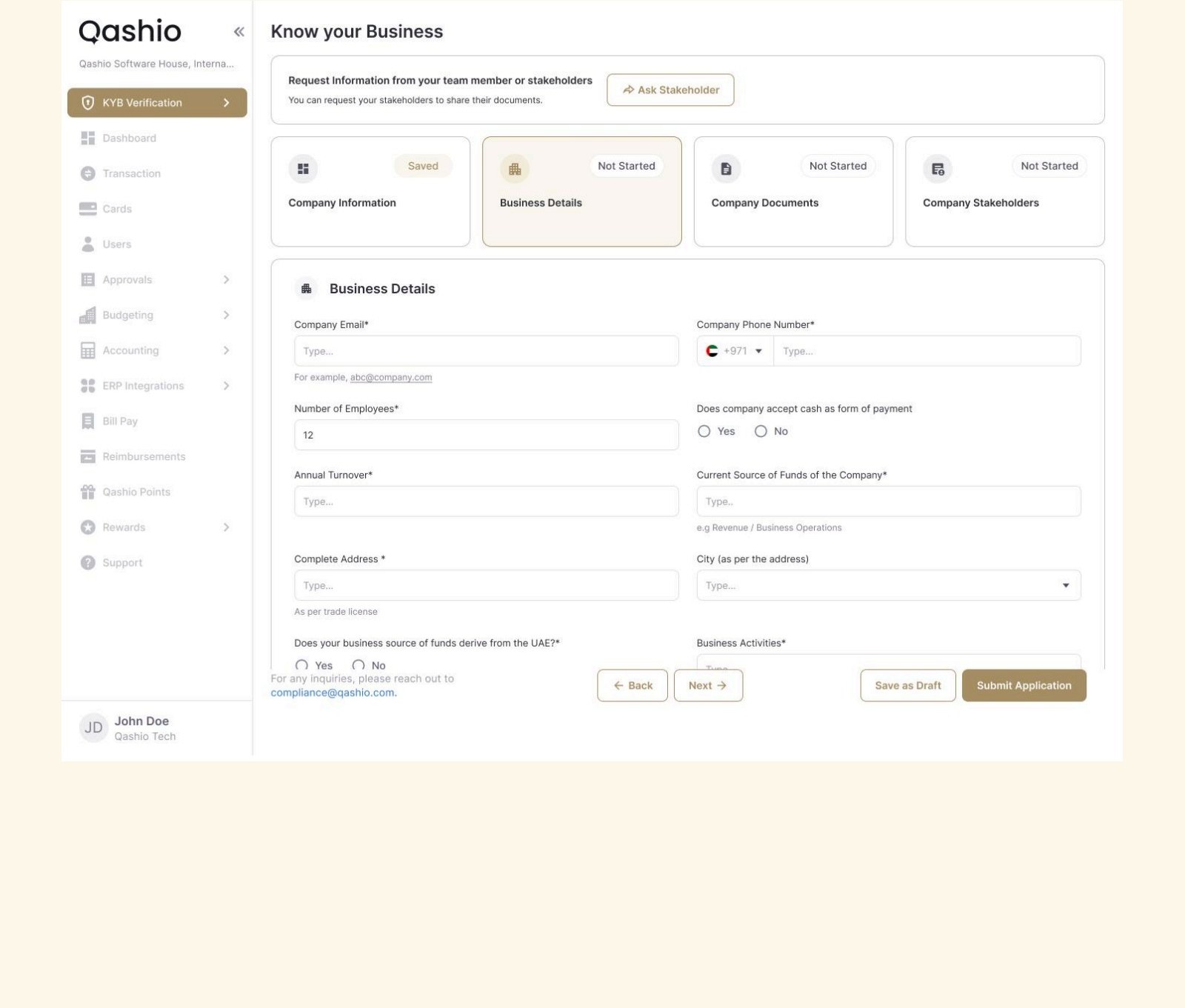
From a flat form to a sectioned view with live status, inline compliance comments, and stakeholder invites.
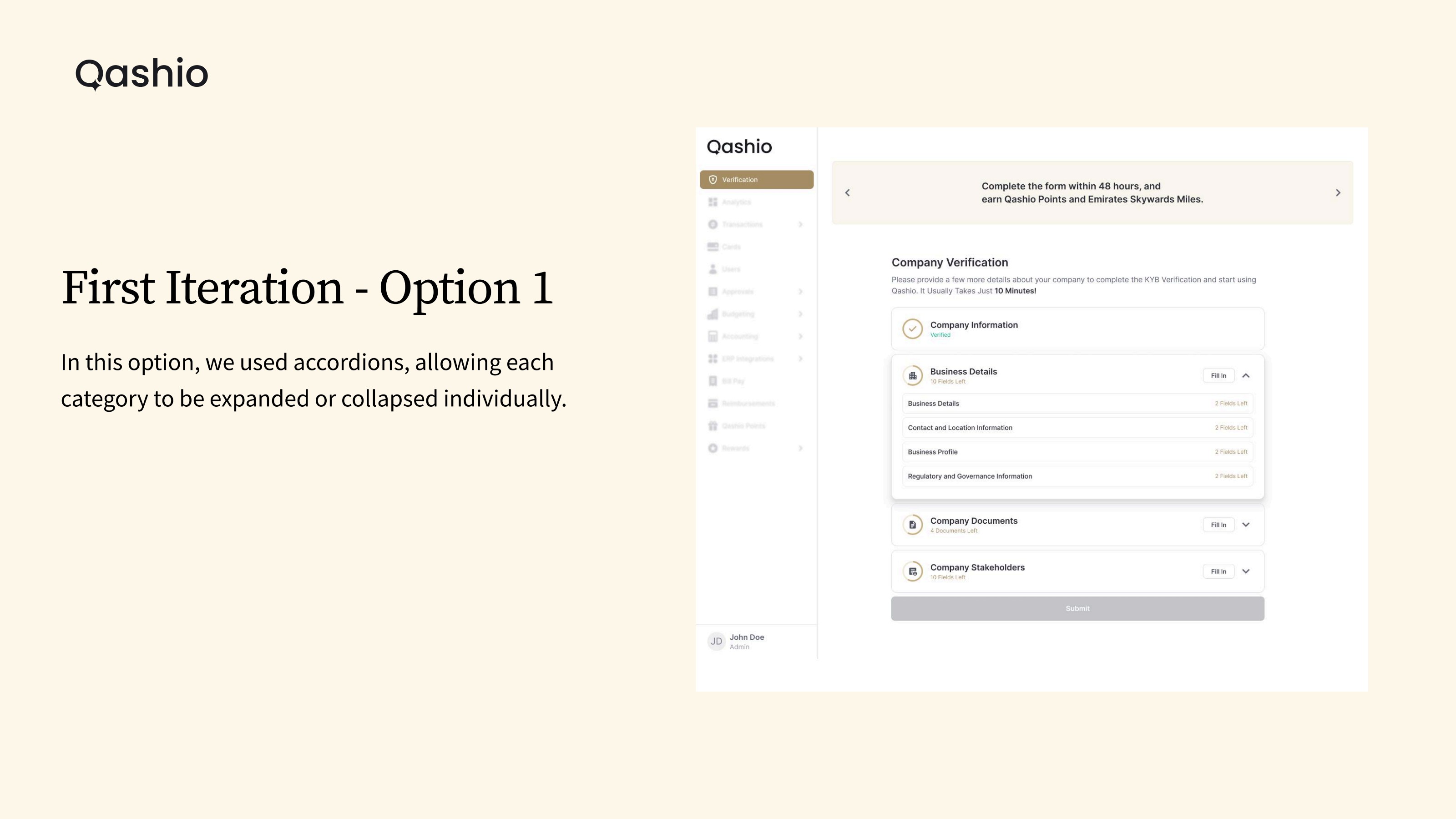
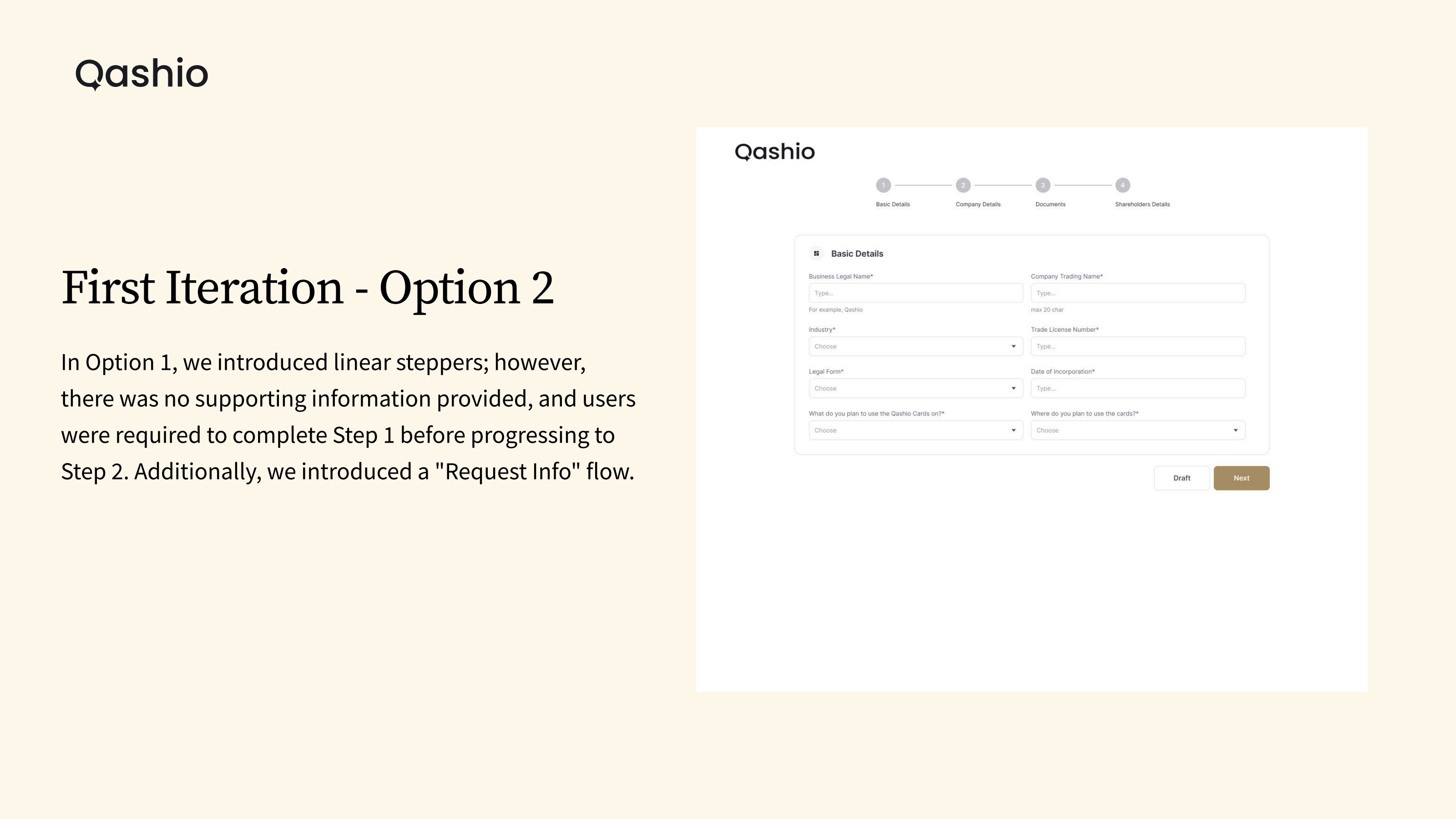
Accordion and linear stepper — both documented and set aside before the sectioned approach earned sign-off.
Deep dive · the Receipt Inbox
Users were attaching receipts to transactions one at a time, wrong receipts kept landing on wrong transactions, and duplicates piled up. Budget didn't allow direct interviews, so I ran a structured session with Customer Success — the team closest to daily receipt pain — and framed the work as a receipt hub, not an attachment feature.
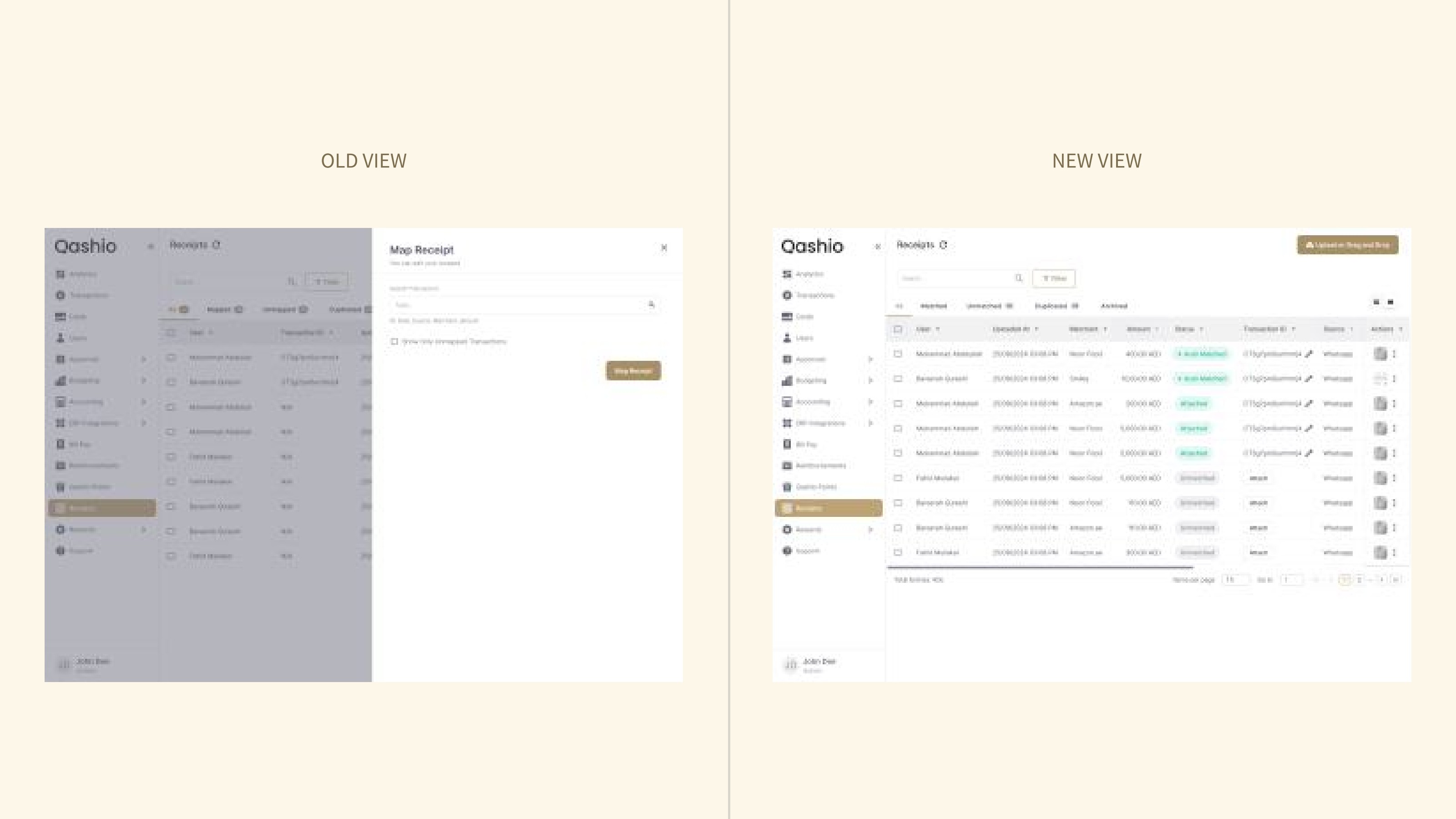
The feature reused existing patterns wherever possible; the two genuinely new interactions were drag-and-drop bulk upload and a floating bulk-action bar that the team later adopted platform-wide. Internal testing with hundreds of real receipts caught a missing preview in the map-receipt flow, and a limited beta surfaced status labels people couldn't parse — renamed to the words finance teams already use: Attached, Unmatched, Duplicate.
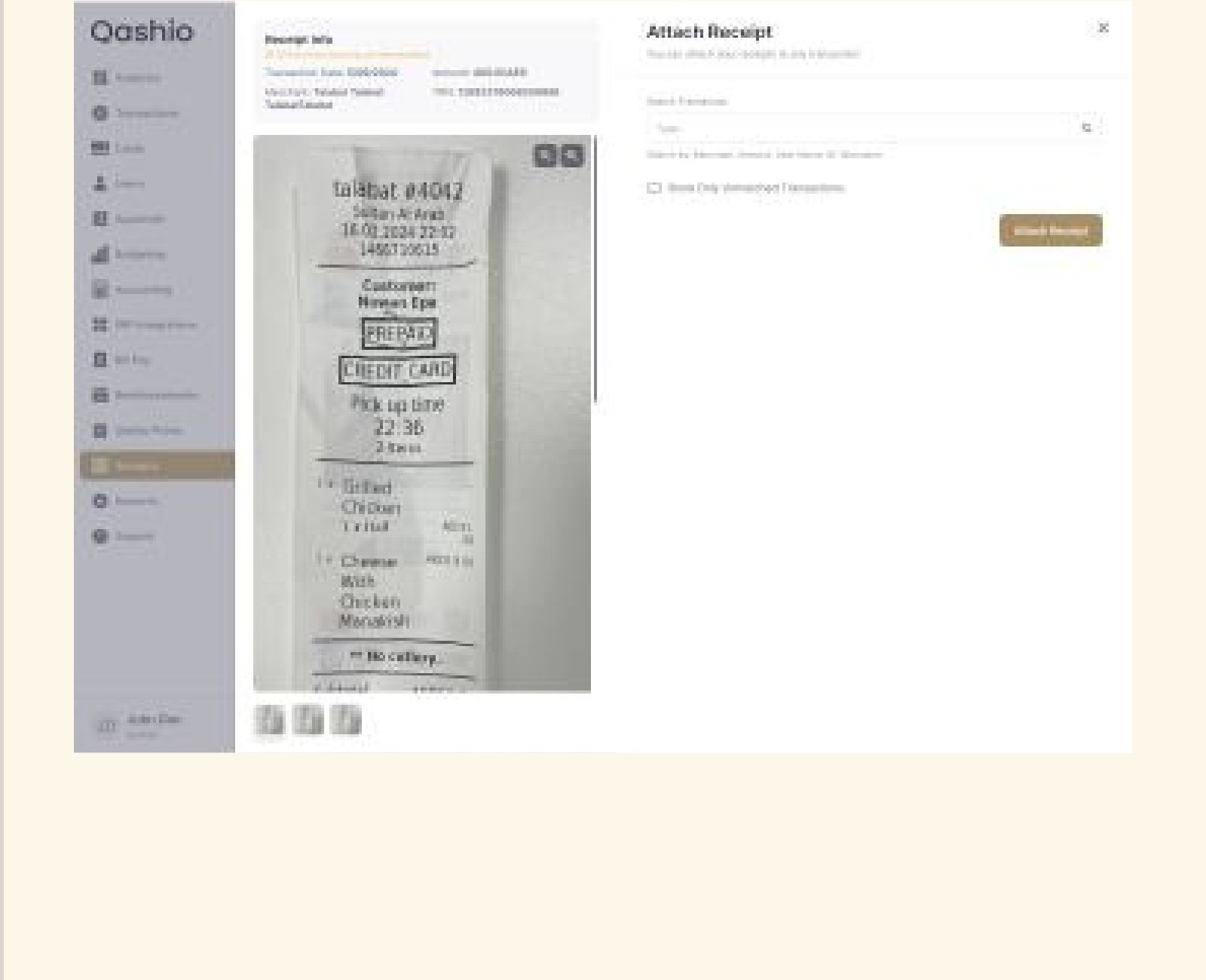
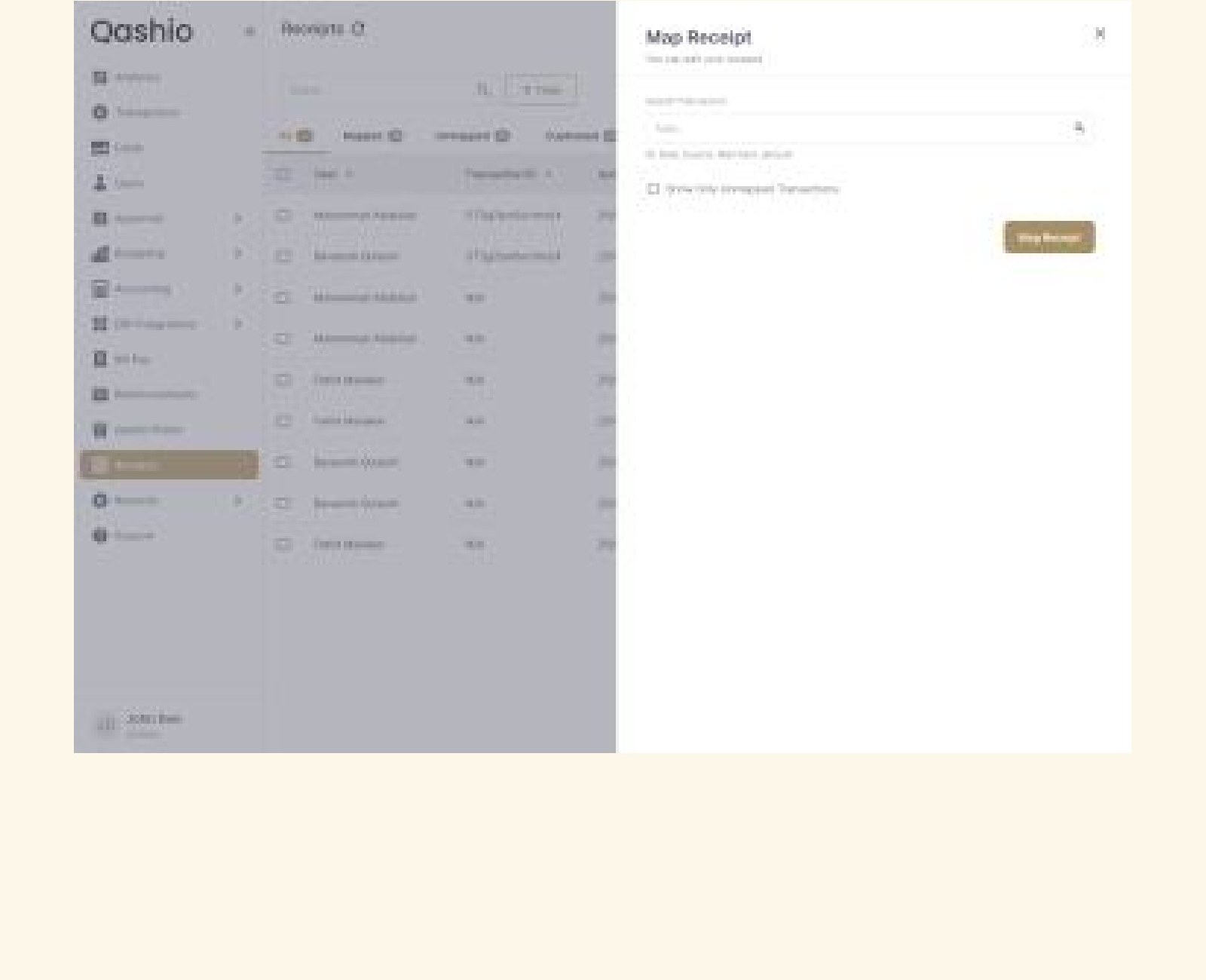
The mapping flow gained a live receipt preview inside the map-receipt flow — drag to compare old and new.
Reflection
The biggest lesson wasn't about the flow. It was about how compliance teams narrate their own work. When the interface reflected the way they already talked — pending, waiting, blocked — every screen felt like a relief instead of a demand.
And the AI matching got the headlines, but the reason the receipt work stuck was the boring interactions and the fast human override one screen away. Autonomy is only worth what people can verify quickly.